
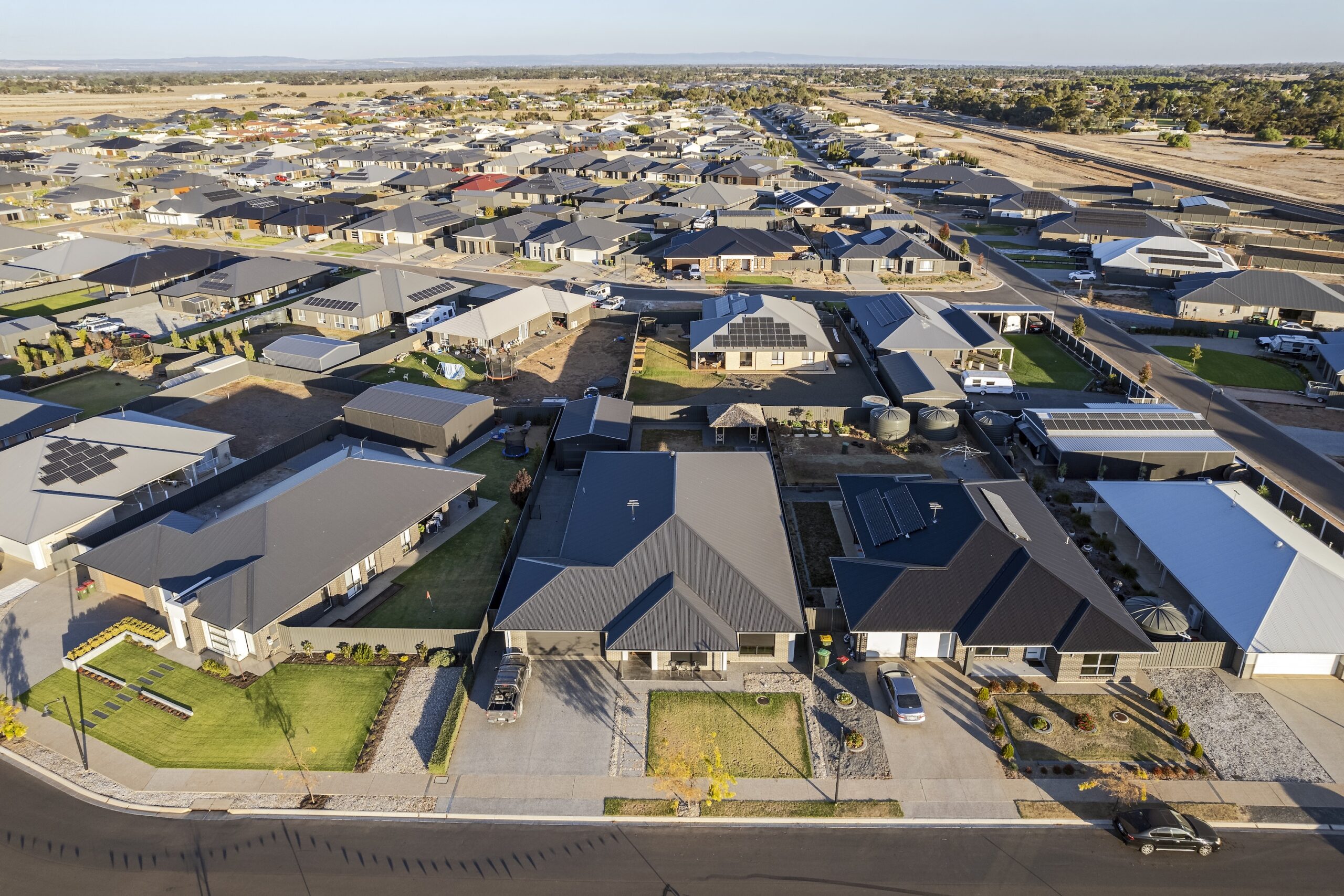
Negative gearing will be limited to new housing, and the capital gains discount will be abolished under sweeping tax reforms delivered in this year’s budget.
Australia’s most controversial property tax breaks will be severely restricted in a move the government says will help 75,000 people buy their first home in the next decade.
Housing formed a centrepiece of what treasurer Jim Chalmers described as “the most important and ambitious budget in decades”, delivered on Tuesday night.
In his budget address, Mr Chalmers said the reforms would “help rebalance a system where house prices have decoupled from incomes.”
“These changes will level the playing field for workers and first-home buyers, and support investment in productive assets, including new housing supply,” Mr Chalmers said.
The much-anticipated tax overhaul comes despite Prime Minister Anthony Albanese repeatedly ruling out changes to negative gearing prior to last year’s election.
Axing tax breaks for property investors and discretionary trusts will raise more than $8 billion over the next five years, most of which will be spent on a $250-per-year tax cut for workers.
It will also help fund $2 billion to be spend on infrastructure to enable the construction of 65,000 new homes in the next 10 years.
But treasury modelling shows the combined effect of the tax reforms will slow house price growth and negatively impact future housing supply while also pushing up rents.
Negative gearing abolished for existing homes
Under previous negative gearing rules, investors whose expenses exceeded rental income, resulting in a loss, could deduct that loss from other income, such as wages.
From 1 July 2027, negative gearing will be limited to only newly built homes in a bid to encourage more housing construction.
Established residential investment properties purchased before 7:30pm on 12 May 2026 will be exempt from the changes until the property is sold. This includes contracts exchanged but not yet settled.
Current owners of negatively geared investment properties will still be able to deduct rental losses from other taxable income.
Investors who purchase established residential properties can still offset rental losses against capital gains when selling, or carry forward losses to offset against rental income in future years.
Commercial properties will be exempt from the changes to negative gearing.
REA Group senior economist Anne Flaherty said the negative gearing would likely drive some investors away from residential property to other investments.
“Commercial property may begin to look more attractive, particularly to those seeking stronger yields and less exposure to changing housing policy,” she said.
“Many investors tolerate low yields when owning residential property because of the tax treatment and long-term capital growth prospects. These changes now alter that equation.”
Capital gains tax discount replaced with indexation model
Investors must pay capital gains tax (CGT) when selling a property, with previous rules giving investors a 50% discount if they hold a property for more than 12 months, meaning tax is only paid on half of the gain.
This discount will be abolished from 1 July 2027, with the old pre-1999 inflation-linked indexation system applying instead.
That means when selling an investment property, the cost base (the purchase price plus any purchase costs such as stamp duty) will be indexed to inflation – a move Mr Chalmers said would “restore the taxation of real gains”.
In addition, a minimum 30% tax rate would apply for capital gains from July next year.
The changes will apply to both property and shares.
Investors who buy new homes will be able to choose from either the existing 50% CGT discount or the indexation method when they sell the property.
Reforming negative gearing and the capital gains tax discount is expected to raise $3.6 billion over the five years from 2025–26.
Infrastructure funding to boost housing supply
On the housing supply front, the budget includes $2 billion in funding for the Local Infrastructure Fund, which is intended to unlock infrastructure such as roads, water, power and sewerage to enable the construction of up to 65,000 homes over 10 years.
The funding will be provided to local governments and state utility providers, with $500 million reserved for regional Australia.
Accessing that funding will be conditional on states and territories committing to pro-housing supply reforms, including faster and simpler approvals and making more land available to build homes.
Tax relief for working Australians
Workers will get $250 per year in tax relief from 1 July 2027 in a move set to benefit 13.3 million Australian taxpayers.
The $250 Working Australians Tax Offset (WATO) will be paid automatically in tax returns every year, starting at the end of 2027-28 financial year.
This measure is expected to cost $6.4 billion over the five years from 2025– 26.
Targeted housing measures
The government has set aside $59.4 million over four years to community housing providers to supplement rental income for social housing for more than 4,000 young people aged 16-24 who are at risk of homelessness.
A further $100 million has been set aside from the Housing Australia Future Fund to improve the quality of housing for First Nations Australians in remote communities.
And in a move that could save builders and tradespeople up to $1,600 a year, all construction standards referenced in Australian legislation will made free.
Additionally, the ban on foreign purchases of established residential dwellings, which was set to expire at the end of March 2027, will be extended until 30 June 2029.
Minimum tax rate for discretionary trusts
Discretionary trusts are commonly used for asset protection, but can also be used to minimise tax.
For example, an investment property can be held in a family trust, and the rental income can be split among beneficiaries such as a spouse or adult children, who may have lower marginal tax rates, or whose income falls below the tax-free threshold.
From 1 July 2028, the government will introduce a 30% minimum tax on discretionary trusts – a move expected to raise almost $4.5 billion by FY29-30.
The government said this will create “a more equal treatment between workers who earn a living from wages and people with income from trusts”.
How tax reforms could affect the housing market
Treasury modelling suggests that tax reforms will reduce investor demand, leading to house prices growing by 2% less “over a couple of years”, saving buyers purchasing a home at the median national house price about $19,000.
However, winding back negative gearing and capital gains tax is expected to result in 35,000 fewer homes being constructed in the next 10 years, treasury modelling shows.
The reforms are also expected to increase median rents by “less than $2 per week”, or about $100 a year, according to treasury.
Tax and housing expert Dr Christian Gillitzer of the University of Sydney said capital gains tax changes would likely result in investors holding onto properties for longer, potentially reducing housing turnover.
“In general, with CGT there is a so-called lock in effect – you only pay the tax when you realise the gain,” he said. “There's an incentive to delay the sale.”
Mr Gillitzer said it was likely that fewer investors would buy properties to flip for a quick profit.
“The current system provides the biggest benefit for people with large gains and short holding periods, so it would tend to discourage that behaviour.”
Housing Industry Association chief economist Tim Reardon said redirecting investor activity to new homes by limiting negative gearing was likely to worsen Australia’s housing supply problem.
“If policy settings reduce investor participation overall, fewer new homes will be built, rental supply tightens further, and the structural shortage worsens,” he said.
“The long-term solution remains increasing housing supply relative to demand. This means lowering the cost of delivering a new home to market, not increasing taxes to further distort the market.”
